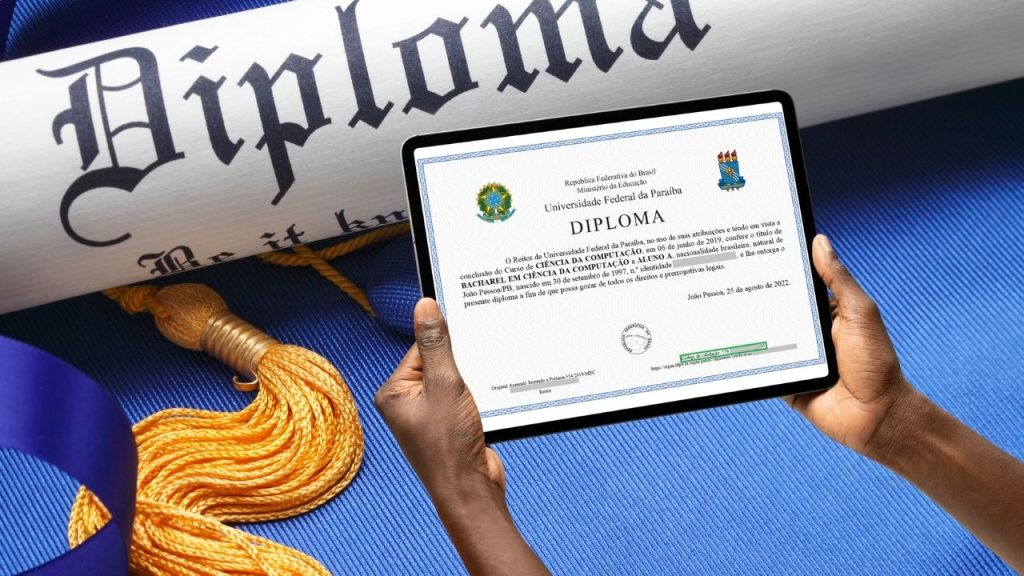
Digital transformation has reached several areas of society, and Brazilian higher education has not been left out with the Digital Diploma!
It represents an important advance in the way higher education diplomas are issued, stored and validated. Are you curious (a) about what this Digital Diploma is, how it works and how to issue it?
What is Digital Diploma?
O Digital Diploma it is the official document that proves the completion of higher education courses, issued and stored exclusively in digital media.
With legal validity guaranteed by laws and ordinances of the Ministry of Education (MEC), it replaces the traditional physical version and has a qualified digital signature, which guarantees its authenticity and integrity.
In addition to the XML file (official document), institutions provide a Visual Representation of the Digital Diploma (RVDD), usually in PDF format, which facilitates human visualization and contains QR Code and validation code.
How does Digital Diploma work?
The Digital Diploma process follows the following steps:
1️⃣ The educational institution issues and signs the digital diploma in XML format, using nationally recognized digital certification.
2️⃣ The document is electronically registered and archived in the institution's systems, ensuring traceability and security.
3️⃣ The trainee accesses his diploma through the academic portal of the institution, being able to download both the XML and the RVDD.
IMPORTANT: Anyone interested can validate the digital diploma by scanning the QR Code of the RVDD or using the authentication code on official platforms.
3 Important points you need to know about the Digital Diploma
1️⃣ Multiple digital signatures: the validity of the digital diploma does not depend only on the signature of the institution. It has additional signatures of academic leaders (eg dean, coordinator) and with the CNPJ certification of the university, making it even safer.
2️⃣ LGPD Compliance: the privacy of the personal data of the student is preserved. The digital diploma does not allow unrestricted public consultation by CPF, protecting the holder from undue exposure.
3️⃣ Technical rigor in XML format: the structure of the digital diploma follows official standards (XSD). If the institution generates a file outside of these specifications, the diploma will be considered invalid.
Advantages and disadvantages of using digital diplomas
It is interesting to note that the existence of digital diplomas has both a positive and negative side:
Advantages:
✅ Eliminates fraud through digital signature and electronic verification.
✅ Simplifies access: the graduate does not need to attend the institution in person.
✅ Reduces costs with printing, paper and delivery logistics.
✅ Facilitates rapid validation by employers and public bodies.
Disadvantages:
⚠️ It requires familiarity with digital platforms, which can be challenging for some people.
⚠️ The printed visual version (RVDD) has no legal validity.
⚠️ It depends on the digital infrastructure of the institution and the secure maintenance of the data.
Frequently asked questions about the Digital Diploma
1. Can the digital diploma be printed?
The XML of the digital diploma should not be printed, as it contains the digital signature that validates the authenticity of the document in electronic format. However, the Visual Representation (RVDD), which is a PDF file of the diploma, can be printed for display purposes or for ceremonies, but has no legal validity. Only XML, when validated electronically, has legal value.
2. Do I need to pay to issue the digital diploma?
No. The issuance of the digital diploma is free for the trainee, according to the guidelines of the MEC. The institution may charge administrative fees only for services such as reissue or correction of data. However, the first issue after the completion of the course has no additional costs.
3. Does the digital diploma have international validity?
The digital diploma, in its current form, has international validity provided that the country of destination accepts electronic documents and has bilateral agreements with Brazil (for example, the Hague Apostille). However, for some countries, it may be necessary to carry out the apostille process so that the diploma is officially recognized outside Brazil. The validity of the digital diploma is regulated by Brazilian Law, and its acceptance may vary according to the legislation of other countries.
4. Does the authentication code expire?
No. The authentication code associated with the QR Code of Visual Representation (RVDD) does not expire. However, the diploma can be revoked if there is fraud or error in the registered data, but this is a process carried out by the educational institutions themselves. The validity of the verification code is permanent, as long as the diploma is valid.
5. Can I access my digital diploma after I graduated?
Yes. The digital diploma can be accessed at any time after graduation, provided that you have access to the portal of the institution where it was issued. The portal offers the possibility to download the diploma again, if necessary. Even if you have completed the course for years, the XML remains valid.
6. Can the digital diploma be revoked?
Yes, the digital diploma can be revoked if any irregularity is proven (eg fraud, error in issuance or problems with student data). The revocation is registered electronically and the diploma will be invalidated. The student will be notified of the revocation by the institution, which, if necessary, can issue a new diploma.
7. Is it possible to consult a digital diploma by CPF?
Currently, the CPF cannot be used directly to consult digital diplomas, due to privacy and data protection issues (LGPD). To validate a diploma, it is necessary to use the verification code present in the QR Code or the XML of the digital diploma. The CPF consultation system is under development and can be implemented in the future, based on digital government guidelines.
8. Is there a risk of counterfeiting?
No, the digital diploma is designed to be extremely secure. It uses digital signatures and ICP certification Brazil, technologies that guarantee the authenticity and integrity of the document.In addition, validation via QR Code and authentication code makes forgery virtually impossible. The digital signature system allows anyone to verify that the document is true, without the need for an intermediary authority.
The digital diploma brings modernity and security to the academic environment, replacing the physical model with practical and legal advantages.
The following is how to issue, validate and ensure that your access is secure to your Digital Diploma!